Professional air conditioning installation for Bakersfield homes and light-commercial properties. From load calculation and equipment selection to ductwork evaluation and post-install commissioning — our team ensures your new cooling system is properly sized, correctly installed, and ready to handle Kern County's demanding summer heat.
Deciding between repairing an existing system and investing in a new installation depends on several factors. These are the most common indicators that Bakersfield homeowners encounter when an aging system approaches the end of its practical service life.
Most residential air conditioning systems have an expected service life of 15–20 years with proper maintenance. Systems approaching or exceeding this range in Bakersfield's demanding climate often experience declining efficiency, more frequent breakdowns, and difficulty sourcing replacement parts. A system evaluation can determine whether continued repair or replacement is the more cost-effective path.
When repair costs begin to accumulate — especially on major components like compressors, coil replacements, or control boards — the total investment may approach or exceed the value of the remaining equipment. A clear repair-versus-replace analysis based on the system's condition and repair history helps homeowners make an informed decision rather than continuing to invest in a declining system.
Rising cooling costs without a corresponding increase in utility rates often indicate declining system efficiency. Older systems with lower SEER ratings, worn components, and degraded refrigerant circuits consume more electricity to deliver the same cooling output. In Bakersfield, where air conditioning accounts for a substantial portion of summer energy use, the efficiency gap between an aging system and a modern high-SEER unit can be significant.
R-22 (Freon) production ended in 2020 under federal regulations. Remaining supplies are limited and increasingly expensive. If your system develops a refrigerant leak and requires a recharge, the cost of R-22 alone may exceed the value of the repair. Modern systems use R-410A or newer refrigerants that are more widely available and environmentally compliant.
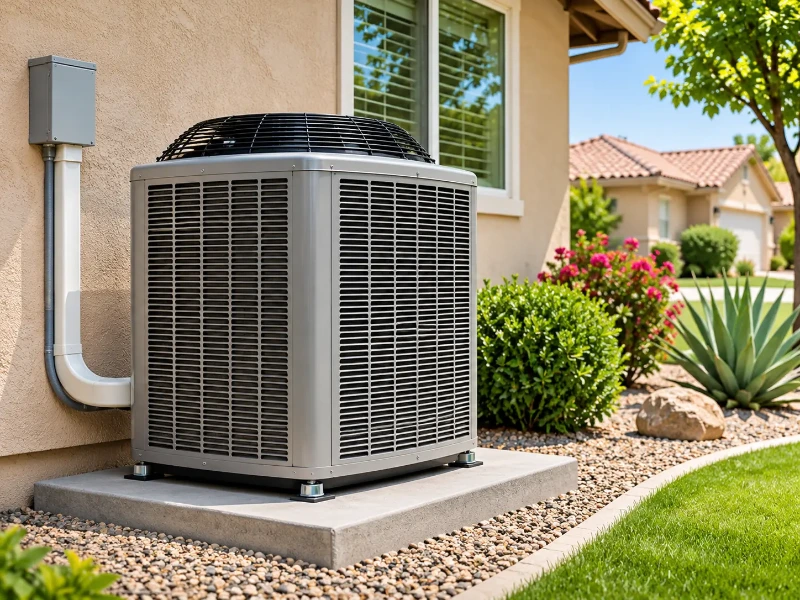
A new air conditioning system is a significant investment, and the quality of the installation directly affects performance, efficiency, and equipment longevity. An oversized system will short cycle, increase indoor humidity, and wear out prematurely. An undersized system will run constantly during Bakersfield's peak summer heat without reaching the desired temperature.
Our installation process starts with a Manual J load calculation that accounts for your home's square footage, insulation, window exposure, ductwork layout, ceiling height, and the specific climate conditions in Bakersfield and Kern County. This data-driven approach ensures the equipment we recommend matches the actual cooling demand of the property — not a rough estimate based on square footage alone.
Every installation is a complete project — not just an equipment swap. Here is what our Bakersfield AC installation scope covers.
A quality AC installation follows a structured sequence to ensure every component is correctly sized, positioned, connected, and tested before the system is handed over to the homeowner.
Before selecting equipment, we evaluate the property — measuring rooms, assessing insulation, inspecting existing ductwork, checking electrical panel capacity, and noting window orientation and shading. A Manual J load calculation translates these findings into the precise cooling capacity your home requires. This step prevents the two most common installation mistakes: oversizing and undersizing the system for the actual thermal load.
Based on the load calculation results, we recommend equipment that matches your home's cooling requirements, budget, and efficiency goals. We work with established HVAC manufacturers to source reliable, warranty-backed equipment suited for Bakersfield's climate demands. The old system is disconnected, the refrigerant is recovered per EPA regulations, and the existing equipment is removed and disposed of properly.
The new indoor and outdoor equipment is positioned, leveled, and secured. Refrigerant lines are brazed and pressure-tested for leaks, electrical connections are made to code, condensate drainage is routed properly, and the system is connected to the existing or modified ductwork. Every connection point is verified before refrigerant is released into the system. Proper installation technique at this stage directly affects equipment longevity, energy efficiency, and warranty coverage.
After installation, the system is started and run through a full commissioning sequence — verifying refrigerant charge by measuring subcooling and superheat, checking airflow volume across the evaporator, confirming thermostat communication, and testing all operational modes. We walk you through the new system's operation, filter access, thermostat programming, and recommended maintenance schedule. Documentation including warranty registration details is provided for your records.
Our team evaluates your property, calculates the cooling load, and recommends equipment options that match your home's requirements and budget. Clear information — no pressure.
Age, repair history, efficiency decline, and refrigerant type all factor into this decision. Systems older than 12–15 years, those requiring frequent costly repairs, or units still using R-22 refrigerant are often more cost-effective to replace. A thorough system evaluation helps determine whether repair or replacement is the more practical long-term option. Our AC repair team can assess whether your current system is worth repairing.
Proper sizing requires a load calculation that accounts for the home's square footage, insulation levels, window area and orientation, ductwork condition, ceiling height, and the local climate. In Bakersfield, where outdoor temperatures regularly exceed 100°F, an undersized system will struggle to maintain comfort, while an oversized unit will short cycle and increase humidity indoors.
A standard residential AC replacement — where the ductwork and electrical are already in place — typically takes one full day. Installations that require new ductwork, electrical upgrades, or structural modifications may take two or more days depending on the scope.
Federal minimums for the Southwest region require a minimum of 15 SEER2 for split systems. Higher SEER ratings (17–21+) reduce operating costs in Bakersfield's extended cooling season but come at a higher upfront cost. The ideal rating depends on your budget, how long you plan to stay in the home, and your energy priorities.
It should. Even the most efficient new system will underperform if connected to leaky, undersized, or poorly routed ductwork. Our installations include a ductwork assessment to identify leaks, restrictions, or sizing issues that could compromise the new system's performance. For properties with significant duct issues, our ductwork and air quality service addresses those separately.
Explore our other heating, cooling, and air quality services for Bakersfield properties.
View all Bakersfield HVAC services we provide for Kern County properties.