Professional furnace repair for Bakersfield homes and light-commercial properties. From furnaces that fail to ignite and blowers that stop circulating air to gas valve issues and heat exchanger concerns — our team diagnoses heating system failures and completes targeted repairs to restore safe, reliable warmth for Kern County properties.
Although Bakersfield's heating season is shorter than its cooling season, overnight temperatures during winter can drop into the 30s and 40s. A furnace that has been idle for months may reveal problems when it is first called to operate, making early recognition of warning signs especially important.
When the thermostat calls for heat but the furnace does not ignite, the problem may involve a cracked hot surface igniter, a faulty flame sensor, a closed gas valve, a tripped pressure switch, or a control board issue. Modern furnaces use electronic ignition systems that can fail after repeated thermal cycling over several heating seasons. In Bakersfield, where furnaces sit idle through long, hot summers, components can also be affected by dust accumulation and corrosion from prolonged inactivity.
A brief smell when the furnace first starts after months of being off is common — dust burning off the heat exchanger. However, a persistent burning smell, metallic odor, or the unmistakable rotten-egg scent of natural gas indicates a problem that requires immediate professional attention. Gas leaks, overheating components, and electrical shorts each produce distinct odors that trained technicians can identify and address safely.
A loud bang when the furnace ignites may indicate delayed ignition — gas accumulating in the combustion chamber before the igniter activates. Popping or pinging from the ductwork as it expands and contracts is usually structural, but persistent rumbling from the furnace itself can suggest a dirty burner, a flame rollout condition, or a draft-related combustion issue that should be evaluated promptly.
When a furnace cycles on and off in short intervals without adequately heating the home, it is typically a safety shutdown triggered by the high-limit switch — often caused by restricted airflow from a dirty filter, a failing blower motor, or blocked return vents. A dirty flame sensor can also cause the furnace to shut off seconds after igniting because the control board cannot confirm a stable flame.
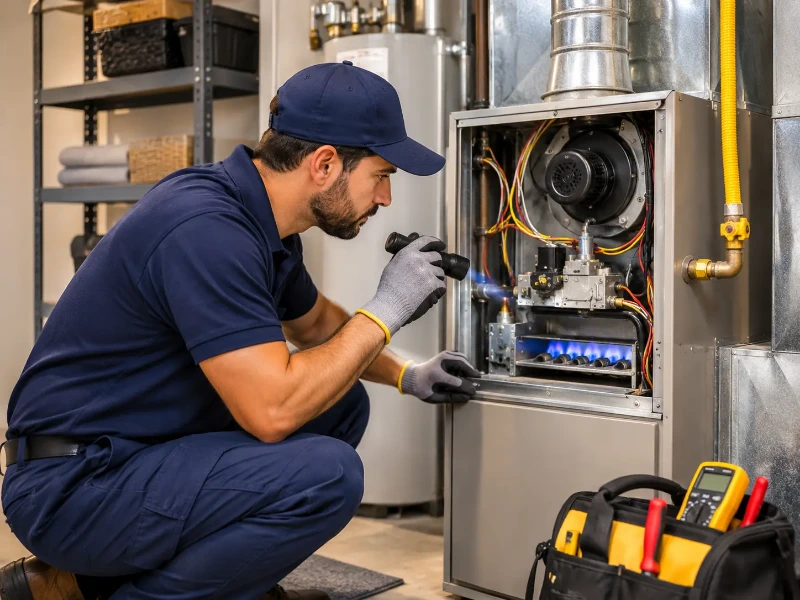
Gas furnaces involve combustion, electrical controls, and gas distribution — systems where a proper diagnosis is not just about comfort but about safety. Our technicians follow a structured diagnostic process that evaluates the ignition sequence, combustion quality, heat exchanger condition, gas pressure, venting integrity, and carbon monoxide levels before recommending any repair.
Because Bakersfield furnaces often sit unused for six or more months through the summer, the first startup of the heating season can reveal issues that developed during the idle period — including pest intrusion in vent pipes, corrosion on flame sensors, and dust-clogged burner orifices. A pre-season checkup through our HVAC maintenance service helps catch these issues before they affect your comfort or safety.
Our furnace repair scope covers the most common heating system failures found in Bakersfield residential properties.
Each furnace repair begins with a thorough diagnostic evaluation to confirm the source of the issue and determine whether repair is safe and practical before any work is performed.
The hot surface igniter is one of the most frequently replaced furnace components. Made of silicon carbide or silicon nitride, igniters develop micro-cracks from repeated heating and cooling cycles that eventually cause them to fail. The flame sensor — a small metal rod positioned in the burner flame — verifies that gas has ignited successfully. When coated with oxidation or combustion residue, it cannot detect the flame, causing the control board to shut off gas flow as a safety precaution. We test igniter resistance, clean or replace flame sensors, and verify the complete ignition sequence operates correctly.
The heat exchanger is the metal chamber where combustion gases heat the air that circulates through your home. Over years of thermal expansion and contraction, cracks can develop in the exchanger walls. A cracked heat exchanger poses a serious carbon monoxide risk because it allows combustion byproducts to mix with the conditioned air stream. Our inspection includes visual examination, combustion analysis, and CO testing in the supply air to evaluate exchanger integrity. If a crack is confirmed, the furnace must not be operated until the exchanger is replaced or the unit is retired.
The blower motor circulates heated air through the duct system, while the draft inducer motor creates the combustion airflow needed for proper venting. When either component fails, the furnace may not start its ignition sequence (draft inducer) or may produce heat that never reaches the living space (blower). We test motor amperage, inspect capacitors, check relay circuits, and replace failed components to restore proper heating airflow and combustion draft.
The gas valve regulates fuel flow to the burners, the pressure switch confirms proper draft before allowing ignition, and the flue or vent pipe safely exhausts combustion gases outdoors. A stuck gas valve can prevent ignition or allow too much gas into the combustion chamber. A failed pressure switch will lock the furnace out of its ignition sequence. A blocked or disconnected vent pipe creates backdraft and carbon monoxide risks. These components require careful testing, adjustment, or replacement by qualified technicians following manufacturer specifications and local codes.
Our team evaluates the heating system, identifies the failure, and provides a clear scope of work before repairs begin. Safety is always the first priority.
Each furnace repair follows a structured, safety-first process designed to confirm the problem, verify safe operation, and complete the work with quality parts.
We check gas pressure, verify carbon monoxide levels, inspect the heat exchanger, and evaluate the complete ignition and combustion sequence to identify the failure and confirm safe operating conditions.
You receive a written explanation of the diagnosed issue, the recommended repair, and what the work involves — before we proceed. If the furnace has a safety issue that makes repair inadvisable, we will tell you directly.
Our technicians complete the repair using compatible manufacturer parts and follow industry safety standards. We address the root cause and verify that all safety controls are functioning correctly after the repair.
After the repair, we run the furnace through multiple heating cycles to confirm proper ignition, stable flame, correct temperature rise, and safe combustion gas venting before leaving the property.
A furnace blowing cold air may have a failed igniter, a faulty flame sensor, a tripped high-limit switch, a gas valve issue, or a thermostat set incorrectly. The system's safety controls are designed to shut off gas flow if ignition fails or if the heat exchanger overheats, which results in the blower circulating unheated air.
Yes. If you smell a strong gas odor near the furnace or anywhere in your home, leave the building immediately without operating light switches or electronics. Contact your gas utility provider or emergency services from a safe location. Do not attempt to diagnose or operate the furnace yourself.
Furnaces should be inspected and serviced at least once per year, ideally before the heating season begins. Annual maintenance helps identify worn components, verifies safe combustion, checks heat exchanger integrity, and ensures the system operates efficiently when cold weather arrives.
A cracked heat exchanger is a serious safety concern because it can allow combustion gases — including carbon monoxide — to mix with the household air supply. If a crack is confirmed during inspection, the furnace should not be operated until the heat exchanger is replaced or the system is retired.
This behavior, called short cycling, is often caused by a dirty flame sensor, an overheating condition from restricted airflow, a faulty high-limit switch, or a thermostat issue. The furnace's built-in safety controls shut the system down when they detect abnormal operating conditions to prevent damage or hazard.
Explore our other heating, cooling, and air quality services for Bakersfield properties.
Learn more about our full range of Bakersfield HVAC solutions for residential and commercial properties.